

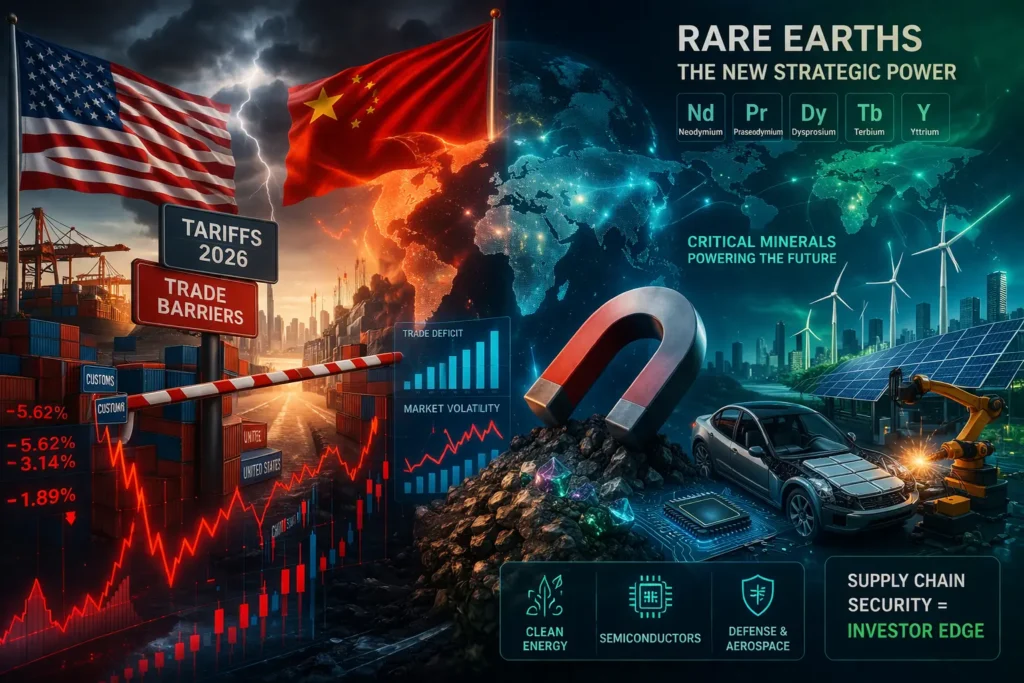
April 2026 update: This article explains the latest US-China tariff escalation, rare earth supply-chain risks, and what investors should watch before reacting to market headlines.
US-China Trade War 2026: What Tariffs and Rare Earth Tensions Mean for Investors
Quick summary: The US-China trade war in 2026 is no longer just about tariffs on goods. It is also about supply-chain power, rare earth dependence, industrial strategy, and market positioning. For investors, this means the impact is broader than headline politics. Tariffs can affect inflation, margins, and trade flows, while rare earth tensions can hit sectors like EVs, clean energy, semiconductors, defense, and advanced manufacturing. The real lesson is simple: do not react to the headline alone — understand which parts of the market are actually exposed.
Whenever the US-China trade war returns to the headlines, many investors immediately expect one thing: market panic. But 2026 is showing that the story is more complicated than that.
Yes, tariffs still matter. Yes, China’s role in critical minerals and rare earth supply chains matters even more. But the real investment takeaway is not that “everything becomes risky.” It is that different sectors now face very different kinds of risk.
This is why investors need to read the 2026 trade-war story carefully. Some businesses face margin pressure. Some face supply-chain disruption. Some may actually benefit from domestic reshoring, industrial subsidies, defense spending, or alternative sourcing trends. In other words, this is not only a macro fear story. It is also a sector-selection story.
🌍 Why the 2026 Trade War Feels Different
Earlier trade-war phases were mainly discussed in terms of import duties, manufacturing competitiveness, and diplomatic escalation. In 2026, the conversation has become broader.
Now investors are watching three layers at once:
- tariffs that can raise costs and reshape trade routes
- rare earth and critical mineral tensions that can disrupt strategic industries
- geopolitical competition over technology, industrial policy, and supply-chain control
That makes the US-China trade war more than a customs-duty issue. It becomes a market theme linked to inflation, defense, semiconductors, EV supply chains, clean energy infrastructure, and long-term capital allocation.
🆕 April 2026 Update: What Has Changed Since This Article Was First Published
When this article was first published, the main concern was that the US-China trade war could become more aggressive again. That concern now feels more real.
In April 2026, the tension moved beyond the usual tariff headlines and started looking more like a broader struggle over strategic materials, industrial capability, and supply-chain control. That is important for investors because this is no longer just a story about import duties. It is increasingly a story about who controls critical inputs, who absorbs the pressure, and which sectors stay resilient when policy turns more aggressive.
For everyday investors, the practical lesson is simple: this theme should not be viewed only through a “market up or market down” lens. It should be viewed through a more useful question — which businesses are exposed, which businesses are adaptable, and which businesses may actually benefit from the shift?
| Fresh 2026 development | What it means in simple investor terms |
|---|---|
| Tariff escalation has become much more aggressive in April 2026 | This increases pressure on trade-sensitive businesses because costs, margins, and earnings visibility can become less predictable. |
| Rare earth tensions are still central, and supply concerns remain highly selective | The risk is not only higher pricing. In some industries, the bigger concern is whether important materials stay easily available at all. |
| The conflict is spreading into areas like strategic manufacturing equipment, not just finished goods | This tells investors that the trade war is becoming deeper and more structural, with implications for clean energy, industrial policy, and advanced manufacturing. |
| More policy action and investigations are still in motion | This means the story is still evolving, so investors should expect more sector-specific developments instead of assuming the worst is already priced in. |
The biggest change since publication is that the US-China trade war now looks even less like a short political episode and more like a long strategic contest. For investors, that usually leads to more selective market reactions. Some businesses face higher uncertainty, while others may benefit from supply-chain diversification, reshoring, or stronger non-China positioning.
That is why long-term investors should stay calm, but also stay alert. A headline-driven reaction is rarely the smartest move. A better approach is to understand which sectors are vulnerable, which ones are gaining strategic importance, and how this theme fits into a diversified portfolio rather than treating it as a reason for panic.
💸 What Tariffs Actually Mean for Investors
Tariffs sound simple: a country taxes imports to protect domestic industry. But from an investor’s perspective, the consequences are rarely simple.
Tariffs can influence markets through several channels:
1. Higher input costs
Companies that rely on imported goods, components, or machinery may face pressure on margins. If they cannot pass those costs to customers, profitability can weaken.
2. Sticky inflation
When import costs rise, some of that pressure can flow into consumer prices. That matters because inflation expectations affect interest-rate outlooks, bond yields, and equity valuations.
3. Supply-chain rewiring
Tariffs often do not eliminate demand. They redirect it. Businesses may move sourcing to Southeast Asia, India, Mexico, or other markets instead of relying directly on China.
4. Earnings uncertainty
Executives and investors dislike unpredictable cost structures. Even if tariffs do not destroy demand, they can delay investment decisions and make guidance less reliable.
Key point: tariffs are not automatically bullish or bearish for the whole market. They are usually redistributive. They create losers, but they can also create new winners.
🧲 Why Rare Earth Tensions Matter More Than Many Investors Think
This is where the 2026 story becomes much more important.
Rare earths are not a niche topic anymore. They sit inside major strategic industries, including:
- electric vehicles
- wind turbines
- industrial motors
- consumer electronics
- semiconductors and advanced hardware
- defense systems and aerospace
That means rare earth tensions can matter even more than tariffs in some cases. A tariff usually raises cost. A supply-chain restriction can threaten availability itself.
For investors, that distinction is huge.
If a business can still source an input at a higher price, it may protect margins later. But if supply becomes delayed, licensed, rationed, or strategically uncertain, the risk becomes operational. Production timelines, expansion plans, and even market share can be affected.
🏭 Which Sectors May Face the Most Pressure?
Not every sector feels the US-China trade war in the same way. The most exposed areas are usually those with deep manufacturing dependence, strategic hardware exposure, or fragile cross-border supply chains.
⚠️ Semiconductors and advanced electronics
This sector is already shaped by export controls, technology restrictions, and geopolitical competition. Any new trade friction can raise uncertainty even if demand remains strong.
⚠️ EV and battery ecosystem
Electric-vehicle supply chains depend on a web of critical minerals, magnets, processing capacity, and manufacturing relationships. That makes them highly sensitive to policy shocks.
⚠️ Industrial manufacturing
Companies that depend on imported inputs, specialist components, or tight inventory systems may struggle if tariffs and supply frictions rise together.
⚠️ Consumer hardware
Consumer electronics brands can face both cost pressure and sourcing complexity when cross-border trade rules tighten.
📈 Which Areas Could Benefit?
Trade wars create disruption, but they also create reallocation. Some industries may gain from this environment.
✅ Domestic manufacturing and reshoring plays
Companies linked to local production, industrial automation, logistics, and alternative sourcing may benefit if businesses accelerate supply-chain diversification.
✅ Defense and strategic materials
Governments tend to prioritize supply security when geopolitical tensions rise. That can support defense-adjacent and strategic-material investment themes.
✅ Alternative critical mineral supply chains
Miners, processors, recyclers, and refining projects outside China may attract more policy attention and investor interest, although this area can still be volatile and execution-heavy.
✅ Select countries gaining from trade diversion
When direct U.S.-China trade becomes more difficult, some manufacturing flows may move toward countries such as India, Vietnam, Mexico, or other regional alternatives.
Important: this does not mean every “non-China” story becomes a great investment. It simply means capital may start favoring businesses with stronger supply resilience and geopolitical positioning.
🇮🇳 What Indian Investors Should Watch
For Indian investors, this theme matters in two different ways.
1. India may benefit from some supply-chain diversification
If global companies want to reduce concentration risk, India can remain part of the long-term conversation around manufacturing, electronics, industrial capacity, and strategic partnerships.
2. Global volatility can still spill into Indian markets
Even if India benefits structurally, trade-war headlines can still trigger risk-off behavior, currency moves, margin concerns, and foreign investor caution in the short term.
That means Indian investors should avoid two extremes:
- assuming the trade war is irrelevant to India
- assuming every trade-war headline means they should panic
The smarter view is balanced: short-term volatility can rise, but long-term opportunity can also expand.
🧠 What Should Long-Term Investors Actually Do?
This is the most important part.
If you are a long-term investor, the goal is not to predict every tariff headline or diplomatic twist. The goal is to understand how these developments affect portfolio construction.
A practical approach looks like this:
- stay diversified instead of making one big geopolitical bet
- watch sector exposure more carefully than headline fear
- avoid chasing trendy “beneficiary” stocks after sudden spikes
- focus on balance-sheet strength and pricing power
- treat geopolitical themes as risk factors, not your entire investment strategy
For SIP investors, the lesson is even simpler. Volatility created by headlines is not always a reason to stop. In many cases, it is a reason to stay disciplined and avoid emotional decisions.
Investor takeaway: The US-China trade war in 2026 is not just about tariffs. It is about who controls supply chains, who absorbs higher costs, and which countries and companies become more strategically important.
✅ Final Verdict
The US-China trade war 2026 matters because it touches inflation, manufacturing, technology, industrial policy, and critical minerals all at once.
Tariffs can raise costs and redirect trade. Rare earth tensions can create deeper strategic pressure because they affect the building blocks of modern industry. Together, they make markets more selective.
So what should investors remember?
- do not treat the whole market as one trade-war bet
- watch supply-chain exposure carefully
- expect sector divergence, not uniform market behavior
- focus on resilience, diversification, and business quality
Final bottom line: In 2026, the US-China trade war is less about dramatic slogans and more about practical portfolio consequences. Investors who understand that difference will react more intelligently than those who simply follow the headlines.
🔗 Related Reading on SipPlan
- Iran War Impact on Oil, Stocks, and Inflation in 2026
- War Impact on Indian Market: Oil, Rupee, FII Selling and What SIP Investors Should Know in 2026
- SIP During War 2026 – Should You Stop or Invest More?
- Gold vs Stocks vs Cash: What Is the Best Safe Haven in 2026?
🌐 Useful External Resources
- IEA Global Critical Minerals Outlook 2025
- IEA on Critical Mineral Export Controls
- USGS Rare Earths Statistics and Information
❓FAQ
What is the main investment risk in the US-China trade war in 2026?
The biggest risk is not only tariffs. It is the combination of higher costs, weaker supply visibility, and pressure on strategic sectors such as semiconductors, EVs, electronics, and industrial manufacturing.
Why are rare earth tensions so important for investors?
Because rare earths are used in high-value sectors like EVs, wind turbines, defense systems, electronics, and industrial motors. Supply disruptions can affect availability, pricing, and production timelines.
Can trade wars create investment opportunities too?
Yes. Some domestic manufacturing plays, strategic-material projects, defense-linked sectors, and countries benefiting from supply-chain diversification may gain from the shift.
Should Indian investors worry about the US-China trade war?
They should pay attention, but not panic. The trade war can increase global volatility, yet India may also benefit from long-term diversification of manufacturing and supply chains.
Should SIP investors stop investing during trade-war volatility?
For most long-term investors, no. SIP discipline is usually more valuable than reacting emotionally to macro headlines, unless your goals, time horizon, or risk capacity have changed.
Plan smarter with SipPlan: Use the SipPlan tools and calculators to stay focused on long-term decisions instead of reacting to every geopolitical headline.
Next step
Use this guide to take one clear action.
