

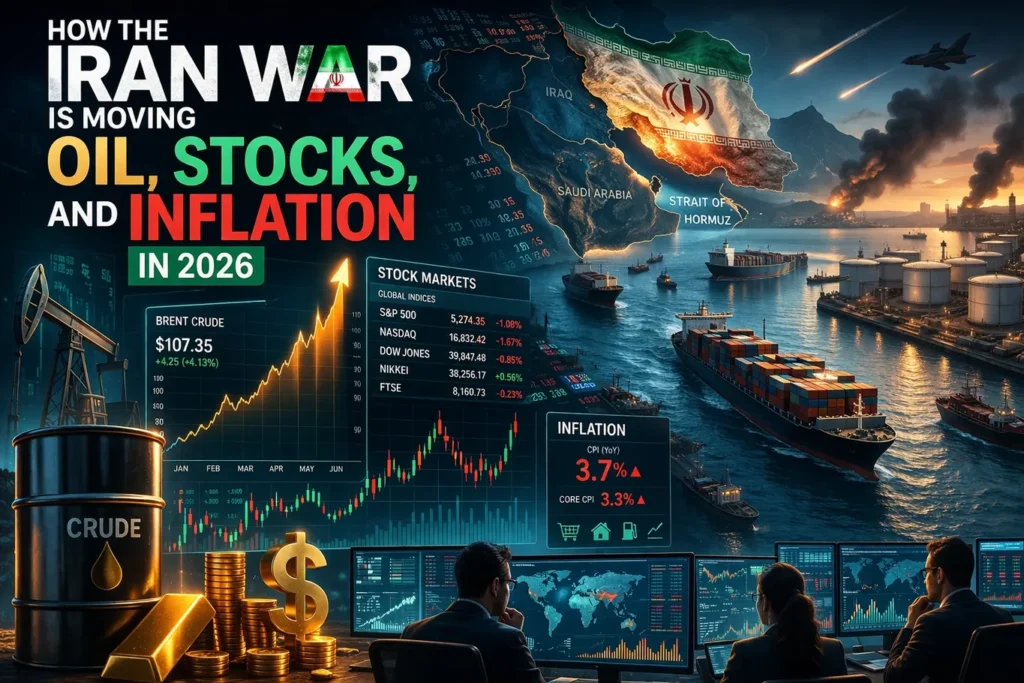
Iran War Impact on Oil, Stocks, and Inflation in 2026 is now one of the biggest global market themes investors are watching. Rising crude prices, inflation pressure, and stock market volatility are all becoming closely linked as geopolitical tensions reshape expectations in 2026.
Quick Summary: The Iran war is affecting markets through oil first, then inflation expectations, then interest-rate hopes, and finally stock-market sentiment. That is why investors across equities, gold, bonds, and cash are watching this conflict closely in 2026.
Why This War Matters So Much to Financial Markets
Not every geopolitical conflict affects global markets equally. This one matters because the Middle East sits close to one of the world’s most important energy chokepoints. When traders believe oil supply could be disrupted, they do not wait for the worst-case scenario to happen. They start repricing crude immediately.
That move in oil then spreads across the economy very quickly:
- Fuel becomes more expensive
- Shipping and logistics costs rise
- Airlines and energy-intensive businesses face pressure
- Inflation fears return
- Central banks become more cautious about rate cuts
- Stock valuations begin adjusting
So when investors ask why one war can affect everything from petrol prices to SIP returns, this chain reaction is the answer.
1. Oil Is the First and Fastest Market Signal
The most immediate reaction to the Iran conflict has been in crude oil. That makes sense. Oil is usually the first asset to react when supply routes look vulnerable. Even if actual production has not fully stopped, fear alone can push prices sharply higher because traders start pricing in risk, insurance costs, shipping delays, and possible shortages.
In 2026, that is exactly what investors are seeing. Oil has become the market’s early warning system. Once crude jumps, every other asset class starts recalculating what may come next.
Why oil matters so much
- Energy is a core input cost across the economy
- Many countries still rely heavily on imported crude
- Higher oil can pressure currencies in import-heavy economies
- Oil shocks can revive inflation even when it seemed to be cooling
For countries like India, this matters even more because higher crude prices can feed directly into inflation, fiscal pressure, and market volatility.
2. The Inflation Story Is Getting Complicated Again
For a while, investors hoped inflation was slowly moving under control. But the Iran war has complicated that story. When oil rises sharply, the impact does not stay only at the petrol pump. It begins to flow into transport costs, factory inputs, aviation, shipping, and consumer expectations.
This is where the Iran War Impact on Oil, Stocks, and Inflation in 2026 becomes much clearer. Oil is not just moving on its own. It is re-entering the inflation conversation at exactly the time many investors were hoping for easier monetary policy.
- Consumers pay more for fuel and transportation
- Businesses face margin pressure if they cannot pass costs on
- Central banks worry that inflation could stay sticky
- Bond markets begin pricing in a higher-for-longer rate path
In simple words, a war-driven oil spike can delay the relief investors were hoping for.
3. Why Rate-Cut Hopes Are Suddenly Less Certain
One of the biggest shifts in 2026 is not just about oil itself. It is about what higher oil means for interest rates.
Earlier, many investors were positioned for a friendlier rate environment. But if energy prices keep inflation hotter than expected, central banks may have less room to cut rates. That matters because lower rates normally support stock valuations, borrowing, housing demand, and business sentiment.
Now the market must ask a harder question: What if growth slows, but inflation stays uncomfortable?
That creates a much more difficult setup than a normal soft landing. It can revive mini-stagflation fears, where growth weakens but prices do not cool fast enough. Even if that worst-case scenario never fully happens, markets can still become volatile while investors debate the risk.
For India, the situation is especially important. Higher crude can weaken the rupee, increase imported inflation, and make RBI policy decisions more delicate.
4. Stocks Are Reacting, But Not in One Straight Line
This is where many beginners get confused. If oil is rising and inflation fears are returning, should stocks not simply fall hard?
Not necessarily.
Markets are more complicated than that. In 2026, stocks are reacting in a mixed way rather than a single panic move. Some sessions sell off sharply on fear. Other sessions rebound quickly on de-escalation hopes, strong earnings, or optimism that the conflict will stay contained.
That is why investors are still buying stocks even during a global war scare:
- Some sectors are less exposed to oil shocks
- Large companies often absorb costs better than smaller firms
- AI spending and technology optimism are still supporting sentiment
- Many investors believe geopolitical shocks can fade faster than expected
- Buy-on-dips behaviour remains strong in quality names
So yes, war can pressure stocks. But it does not mean every stock or every market must collapse together.
5. Which Parts of the Market May Benefit, and Which May Struggle?
The smarter question is not simply “Will stocks go up or down?” It is: Which sectors become stronger, and which become vulnerable, if this energy shock lasts longer?
Potential Relative Winners
- Energy companies: Higher crude prices can improve earnings visibility
- Defence businesses: Geopolitical tension often supports spending narratives
- Gold-related assets: Investors often move toward perceived safety
- Some large-cap quality stocks: Strong balance sheets usually handle uncertainty better
Potential Pressure Areas
- Airlines and transport: Fuel costs rise quickly
- Chemicals and industrial users of energy: Margins can come under stress
- Consumer-facing businesses: Higher fuel and food costs can reduce spending power
- Highly valued rate-sensitive sectors: They may struggle if rate cuts get delayed
This is one reason diversification matters. Investors who panic into one single narrative often miss that war-driven markets usually produce both winners and losers at the same time.
6. Why AI Optimism Is Preventing a Full Stock-Market Collapse
Another important reason markets are not behaving like a simple crash story is the continued belief in the AI investment cycle. Big technology companies are still seen as long-term growth engines. Their spending on data centres, chips, and AI infrastructure has kept a strong growth narrative alive even while oil and macro risks have increased.
That does not mean tech is safe from everything. Higher energy costs can still hurt sentiment, valuations, and spending assumptions. But it does explain why equities are not reacting like a single broken asset class.
In other words, the market currently has two major forces fighting each other:
- Negative force: oil shock, inflation pressure, rate-cut delays, and geopolitical fear
- Positive force: resilient earnings pockets, AI spending, dip-buying, and hopes of de-escalation
That tug of war is exactly why price action feels messy in 2026.
7. What This Means for Indian Investors
If you are investing from India, this topic matters more than many global headlines usually do.
Why?
- India is sensitive to imported crude prices
- Higher oil can put pressure on inflation and the rupee
- Bond yields can rise if markets expect more stress
- Equity sentiment can turn volatile even when domestic fundamentals remain decent
That does not automatically mean you should stop investing. It means you should understand the difference between short-term volatility and long-term investing discipline.
Investor Reminder: A war headline can move markets quickly, but your financial plan should not change every time a headline changes. Your asset allocation, emergency fund, SIP discipline, and risk tolerance matter far more than one dramatic market day.
8. What Long-Term Investors Should Actually Do Now
If the Iran war continues influencing oil, stocks, and inflation in 2026, investors should focus less on prediction and more on positioning.
A sensible approach
- Do not stop SIPs only because headlines look scary. Volatility can help long-term investors accumulate more units at lower levels.
- Keep some safer allocation. Cash, FD, or other defensive assets can reduce emotional pressure.
- Avoid overexposure to speculative bets. Geopolitical periods can punish weak businesses quickly.
- Review sector concentration. If your portfolio is too dependent on one fragile theme, rebalance carefully.
- Stay patient with quality assets. Strong businesses and diversified funds usually survive uncertainty better.
If you are still deciding how much safety versus growth you need, these SipPlan comparisons may help:
Quick Market Map
| Market Area | What Is Happening | Why It Matters |
|---|---|---|
| Oil | Volatile and elevated | Drives inflation, margins, and rate expectations |
| Inflation | Cooling trend now under pressure | Could delay rate cuts |
| Stocks | Uneven reaction, not one-way panic | Sector selection matters more than headline fear |
| Gold | Safety demand supported | Acts as a hedge during uncertainty |
| Central banks | More cautious | Higher-for-longer rates can reshape valuations |
Useful References
- U.S. EIA: Global oil outlook and Strait of Hormuz risk
- IMF: How rising oil prices affect inflation and growth
- ISM Services PMI report
- Reuters: U.S. services prices and inflation pressure
- Reuters: RBI outlook amid the oil shock
Conclusion
The Iran War Impact on Oil, Stocks, and Inflation in 2026 is no longer theoretical. It is already visible in energy markets, inflation signals, central-bank expectations, and daily stock-market volatility.
But the message for investors is not panic. The better message is to understand the chain clearly:
- War pushes oil higher
- Oil pressures inflation
- Inflation changes rate expectations
- Rate expectations affect stocks
- Some sectors benefit while others struggle
If you understand that process, you are already ahead of most headline-driven investors. For long-term investors, discipline still matters more than drama.
Frequently Asked Questions
How does the Iran war affect oil prices?
The biggest risk is disruption near major energy routes and supply chains. Even the fear of disruption can push crude prices higher because traders start pricing in shortages, insurance costs, and shipping delays.
Why are stocks not falling equally everywhere?
Because all sectors are not affected the same way. Energy may benefit, transport may struggle, and technology may still hold up if investors believe long-term earnings remain strong.
Can higher oil prices bring inflation back in 2026?
Yes. Higher energy prices can feed into transport, manufacturing, services, and consumer inflation expectations, which makes central banks more cautious.
What should Indian investors do during this type of market volatility?
Most investors should avoid panic decisions, continue disciplined SIP investing if goals are long term, and keep enough defensive allocation such as emergency cash or safer instruments for stability.
Is this a reason to stop SIPs?
Usually no. For long-term investors, volatility often improves SIP accumulation because the same amount buys more units when markets correct.
