

SIP vs RD: Which Is Better for Beginners in 2026?
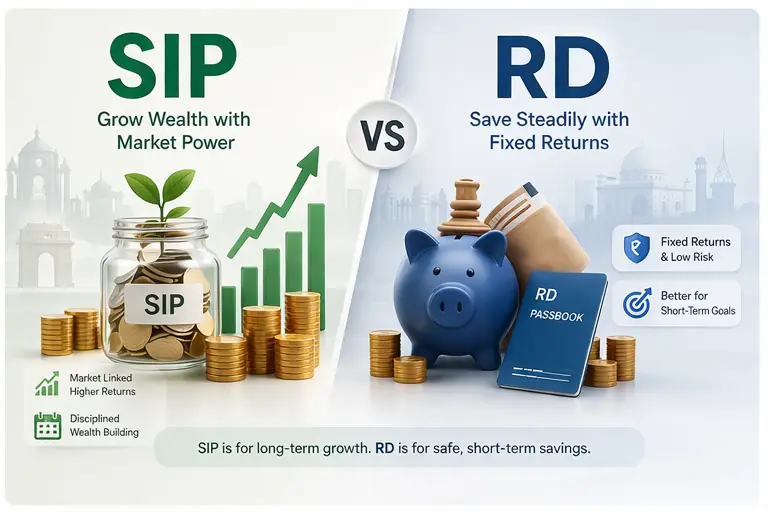
SIP vs RD is a very common comparison for beginners who want to choose between market-linked wealth creation and fixed-return savings. SIP invests in mutual funds and can offer better long-term growth potential, while RD gives predictable returns with lower risk and a fixed savings habit.
SIP
Best for long-term investors who want market-linked growth, flexibility, and a better chance to beat inflation over time.
RD
Best for conservative savers who want predictable returns, capital stability, and a disciplined monthly savings product.
Which one should you choose?
Choose SIP if
You want long-term growth, can handle some volatility, and are investing for goals like wealth creation, retirement, or future milestones.
Choose RD if
You prefer predictable returns, lower risk, and want a safer monthly savings option without market fluctuations.
Best for most growth-focused beginners
SIP is usually the better choice when the goal is long-term wealth creation, while RD suits cautious savers who value stability more.
Understand the core difference faster
Return Type
SIP returns are market-linked. RD gives fixed returns decided by the bank or institution.
Risk Level
SIP carries market risk. RD is lower risk and feels more stable for conservative savers.
Investment Habit
Both build monthly discipline, but SIP is for investing while RD is more of a savings product.
Inflation Impact
SIP has a better chance to beat inflation over time. RD may struggle if inflation stays high.
SIP vs RD comparison table
| Factor | SIP | RD |
|---|---|---|
| Nature | Investment in mutual funds | Bank savings product with fixed monthly deposits |
| Returns | Market-linked and not guaranteed | Fixed and predictable |
| Risk | Higher because of market fluctuations | Lower compared to SIP |
| Best for | Long-term wealth creation | Safe savings and short-to-medium-term comfort |
| Inflation protection | Usually better over long periods | Can be weaker if inflation is high |
| Flexibility | Can pause, stop, or switch funds in many cases | Usually more fixed once started |
| Ideal investor | Growth-seeking investor with time horizon | Conservative saver who wants certainty |
| Potential reward | Higher over long term, but uncertain | Lower, but more stable and known |
Best choice based on investor type
Choose SIP when you want growth over certainty
- You are investing for long-term goals like retirement, future wealth, or a big life milestone.
- You can stay calm when markets move up and down.
- You want a better chance to grow money faster than traditional savings products.
- You understand that returns are not fixed and can vary over time.
Choose RD when safety and predictability matter more
- You want fixed returns and do not want market-related uncertainty.
- You are saving for a near-term goal where capital protection is more important than growth.
- You prefer a traditional savings product from a bank or post office style setup.
- You feel uncomfortable seeing investment value go up and down.
SIP vs RD in different scenarios
You are saving for 2 to 3 years
RD may feel more suitable if your priority is safety and predictable maturity amount for a near-term need.
You want long-term wealth creation
SIP is usually the stronger option because it offers market-linked growth potential and better inflation-beating ability.
You are very risk-averse
RD may be more comfortable because the return is fixed and the product feels easier to understand for conservative savers.
Advantages and disadvantages
SIP: Pros
- Better long-term growth potential
- Can beat inflation more effectively over time
- Suitable for wealth creation goals
- Flexible in many mutual fund setups
- Builds disciplined monthly investing habit
SIP: Cons
- Returns are not fixed
- Market fluctuations can feel uncomfortable
- Short-term outcomes may disappoint
RD: Pros
- Predictable and fixed returns
- Lower risk than SIP
- Simple to understand for beginners
- Good for safe monthly savings habit
RD: Cons
- Lower long-term growth potential
- May not beat inflation comfortably
- Less suitable for aggressive wealth creation
So, SIP or RD?
If your goal is wealth creation and long-term growth, SIP is usually the better option. If your goal is capital safety and predictable returns, RD can be the better fit. For most beginners who want to grow money over many years, SIP often offers a stronger path than RD.
If you want inflation-beating growth, long-term wealth creation, and can accept market fluctuations.
If you want fixed returns, lower risk, and a safer place for monthly savings.
Keep exploring before you decide
Frequently asked questions
Which is better, SIP or RD?
SIP is better for long-term growth, while RD is better for fixed-return safety and predictable savings.
Is RD safer than SIP?
Yes, RD is usually safer in terms of return predictability because it is not exposed to market volatility like SIP.
Can SIP give better returns than RD?
Yes, SIP can potentially give better long-term returns, but those returns are not guaranteed and depend on market performance.
Should beginners choose SIP or RD?
It depends on the goal. Beginners focused on growth may prefer SIP, while those focused on safety may prefer RD.