

SIP vs FD: Which Is Better for Beginners?
SIP vs FD is one of the most searched investment comparisons for beginners. SIP gives market-linked growth potential through mutual funds, while FD offers fixed returns and greater predictability. The better choice depends on your risk tolerance, time horizon, and whether you want stability or long-term growth.
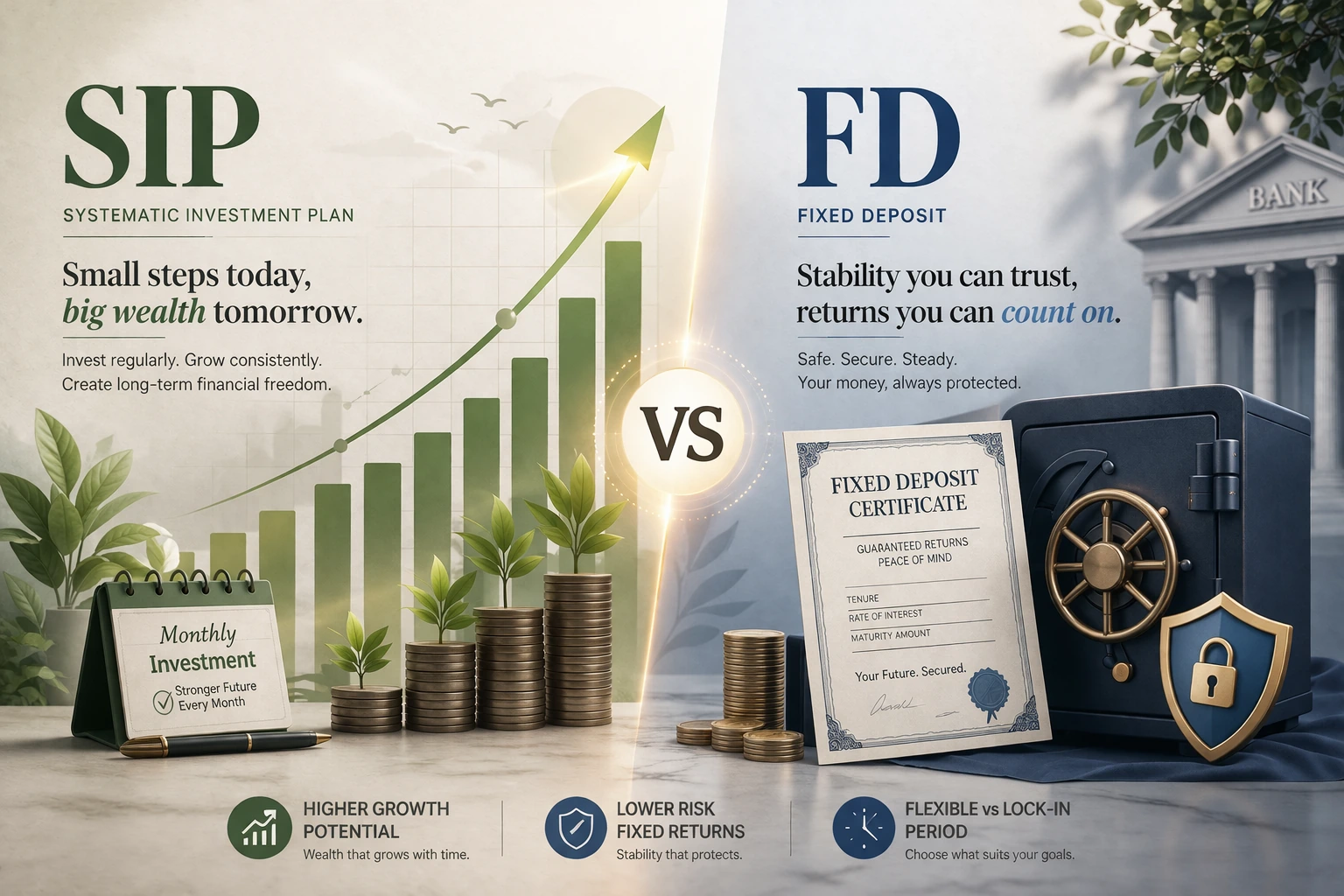
SIP
Best for investors who want long-term growth, inflation-beating potential, and are comfortable with market fluctuations.
FD
Best for conservative savers who want fixed returns, capital stability, and predictable maturity value.
Which one should you choose?
Choose SIP if
You want long-term wealth creation, can stay invested for years, and can handle some ups and downs in value.
Choose FD if
You want safety, fixed returns, and do not want to worry about market volatility affecting your money.
Best for most long-term beginners
SIP is usually better for long-term growth, while FD is better for short-term stability and return certainty.
Understand the core difference faster
Return Type
SIP returns are market-linked and not fixed. FD returns are fixed and known in advance.
Risk Level
SIP carries market risk. FD is lower risk and more suitable for conservative savers.
Inflation Protection
SIP can beat inflation more effectively over time. FD may lag behind if inflation stays high.
Use Case
SIP is better for wealth creation. FD is better for stability, certainty, and capital protection focus.
SIP vs FD comparison table
| Factor | SIP | FD |
|---|---|---|
| Nature | Investment in mutual funds | Fixed-return deposit product |
| Returns | Market-linked and not guaranteed | Fixed and predictable |
| Risk | Higher because of market fluctuations | Lower compared to SIP |
| Best for | Long-term wealth creation | Stable savings and capital preservation |
| Inflation protection | Usually better over long periods | Can be weaker in high-inflation periods |
| Liquidity and flexibility | Flexible in many fund setups, though market value changes | Predictable, but may have penalties on premature withdrawal |
| Ideal investor | Growth-seeking investor with time horizon | Conservative saver wanting certainty |
| Potential reward | Higher over long term, but uncertain | Lower, but more stable and known |
Best choice based on investor type
Choose SIP when you want growth over certainty
- You are investing for long-term goals like retirement, future wealth, or major milestones.
- You can stay invested through market ups and downs.
- You want a better chance to grow money faster than traditional fixed-return products.
- You understand that returns are not guaranteed and can vary over time.
Choose FD when safety and predictability matter more
- You want fixed returns and a known maturity value.
- You are saving for a near-term goal where safety matters more than growth.
- You prefer a traditional product from a bank with simple structure.
- You feel uncomfortable with investment value changing because of market volatility.
SIP vs FD in different scenarios
You need stability for a short-to-medium goal
FD may be more suitable if capital safety and predictable returns are your top priorities.
You want long-term wealth creation
SIP is usually the stronger option because it offers market-linked growth and better inflation-beating potential.
You are very conservative with money
FD may feel more comfortable because the return is fixed and the product is easier to predict.
Advantages and disadvantages
SIP: Pros
- Better long-term growth potential
- Can beat inflation more effectively over time
- Suitable for wealth creation goals
- Builds disciplined investing habit
- Offers flexibility across fund choices
SIP: Cons
- Returns are not fixed
- Market fluctuations can feel uncomfortable
- Short-term performance may disappoint
FD: Pros
- Predictable and fixed returns
- Lower risk than SIP
- Simple to understand for beginners
- Suitable for capital stability
FD: Cons
- Lower long-term growth potential
- May not beat inflation comfortably
- Less suitable for aggressive wealth creation
So, SIP or FD?
If your goal is wealth creation and long-term growth, SIP is usually the better option. If your goal is capital safety and predictable returns, FD can be the better fit. For most beginners with a long time horizon, SIP often offers a stronger path than FD.
If you want inflation-beating growth, long-term wealth creation, and can accept market fluctuations.
If you want fixed returns, lower risk, and a safer place to keep money stable.
Keep exploring before you decide
Frequently asked questions
Which is better, SIP or FD?
SIP is better for long-term growth, while FD is better for fixed-return safety and predictability.
Is FD safer than SIP?
Yes, FD is generally safer in terms of return predictability because it is not exposed to market volatility like SIP.
Can SIP give better returns than FD?
Yes, SIP can potentially give better long-term returns, but those returns are not guaranteed and depend on market performance.
Should beginners choose SIP or FD?
It depends on the goal. Beginners focused on growth may prefer SIP, while those focused on safety may prefer FD.