

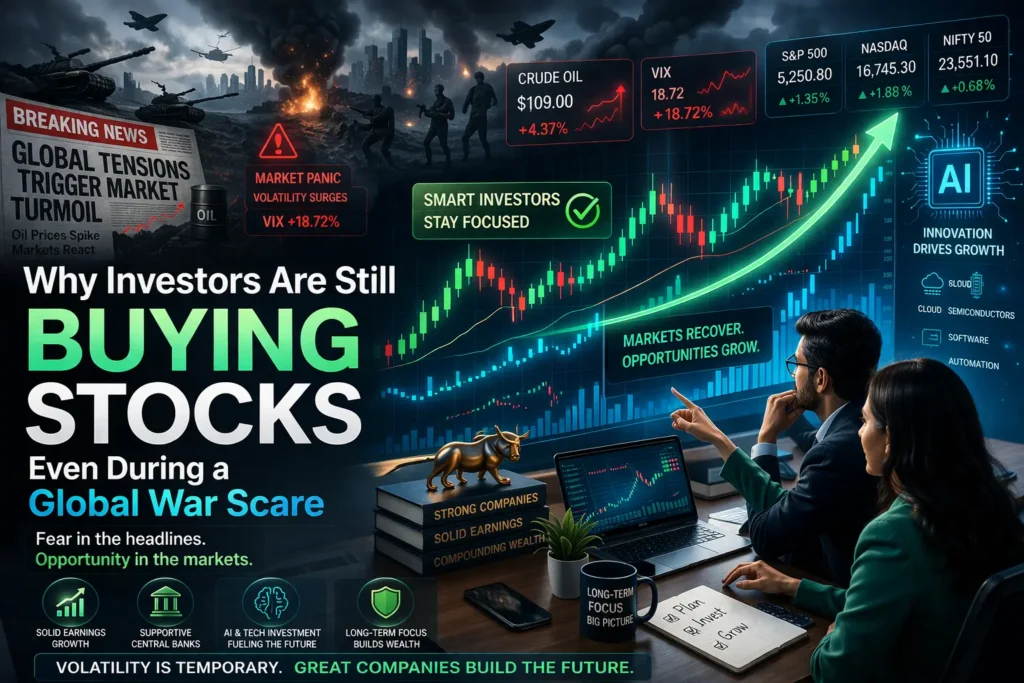
Why investors are still buying stocks even during a global war scare is one of the biggest market questions in 2026. At first glance, it seems irrational. Oil prices have surged, inflation worries are back, and every new geopolitical headline appears capable of shaking sentiment again. Yet investors are still putting money into equities, and that tells us something important about how markets actually work.
Quick Answer: Investors are still buying stocks because markets are forward-looking. Many believe the war scare will eventually ease, earnings growth will remain strong in key sectors, artificial intelligence will keep supporting long-term optimism, and pullbacks are creating selective buying opportunities rather than a reason to abandon equities completely.
Why This Feels Surprising to So Many Investors
War headlines usually create fear, and fear usually pushes investors toward safer assets. That part is true. But the stock market does not only react to today’s fear. It also tries to price tomorrow’s recovery, next year’s earnings, and the longer-term economic story.
That is exactly why stocks do not always collapse in a straight line during geopolitical stress. Some investors step back, but others start asking a different question: What if this panic becomes a buying opportunity?
That mindset is a big reason equities are still attracting interest even in the middle of a global war scare.
1. Markets Are Forward-Looking, Not Just Headline-Driven
The first reason investors keep buying stocks is simple: markets price the future, not just the present.
If investors believe the war shock will eventually stabilise, oil will cool from peak panic levels, and business activity will continue, then they will not necessarily wait for the perfect headline before buying. By the time the news feels comfortable again, a lot of the recovery may already be priced in.
That is why experienced investors often do not ask only, “How bad is the news today?” They ask, “How much of this fear is already reflected in stock prices?”
2. Strong Earnings Expectations Are Still Supporting Equities
Another major reason investors are still buying stocks is that earnings expectations have not disappeared.
Even with the war-driven oil shock, many investors still see profit resilience in parts of the market. Large companies with pricing power, strong cash flow, and healthier balance sheets are often seen as capable of handling uncertainty better than weaker businesses.
That is especially true in areas where long-term secular growth is still intact. When investors believe earnings can stay solid after the panic fades, they become more willing to buy during periods of fear.
3. The AI Story Is Still Too Big for Investors to Ignore
One of the biggest reasons stocks are still attracting buyers in 2026 is the ongoing AI investment cycle.
Technology companies are still spending heavily on data centres, chips, cloud infrastructure, and AI capabilities. That has kept a major growth narrative alive even while geopolitical tensions and oil prices have created macro uncertainty.
In simple words, many investors are thinking like this:
- Yes, war is a real risk.
- Yes, inflation can delay rate cuts.
- But AI-driven growth and earnings opportunities are still large enough that completely avoiding stocks may be the bigger long-term mistake.
That does not mean every tech stock is safe. It means the broader AI theme is still powerful enough to attract capital during market weakness.
4. Investors Are Buying Selectively, Not Blindly
Another important point is that investors are not buying everything. They are usually buying selectively.
That distinction matters. During a global war scare, investors often avoid the weakest parts of the market and focus on areas they believe can still hold up:
- Large-cap companies with stronger balance sheets
- Technology names with durable earnings visibility
- Businesses with less direct exposure to energy-cost shocks
- Quality companies that become cheaper after a selloff
So the continued buying does not always mean investors are carefree. Often, it means they are being more selective about where they want risk.
5. Pullbacks Create Opportunity for Long-Term Investors
Long-term investors know that fear can create opportunity. When stock prices fall because of panic rather than because of permanent business damage, some investors see that as a chance to buy quality assets at better valuations.
This is one reason why “buy the dip” behaviour often survives even during serious geopolitical tension. Investors who missed earlier rallies may use market corrections to slowly build positions instead of waiting for perfect clarity.
Important reminder: A falling market does not automatically mean a bad investment. Sometimes it simply means future returns are becoming more attractive for patient investors.
6. Not Every War Shock Becomes a Long-Term Market Disaster
History has taught investors something important: many geopolitical shocks feel huge in the moment, but markets often stabilise faster than emotions do.
That does not mean war is harmless. It means investors know that markets can absorb terrible headlines if they believe the economic damage will remain manageable or temporary.
This is why some people keep buying stocks even while news flow still looks frightening. They are betting that the market’s long-term direction will depend more on earnings, policy, and business adaptation than on panic alone.
7. Cash and Gold Are Useful, but They Do Not Replace Equities
Defensive assets matter in uncertain times. Cash can give stability. Gold can act as a fear hedge. But for many investors, neither one fully replaces stocks.
Why? Because equities still offer something the others do not: long-term compounding.
If an investor moves entirely into cash or gold every time the world becomes uncertain, they may protect themselves emotionally, but they can also miss the recovery that often comes before confidence fully returns.
That is why many investors do not choose between safety and stocks in an absolute way. They use a mix:
- Cash for liquidity and peace of mind
- Gold for crisis diversification
- Stocks for long-term wealth creation
8. Indian Investors Are Seeing the Same Tug of War
This debate is not only happening in the U.S. or Europe. Indian investors are seeing it too.
Higher crude prices are a clear risk for India because they raise the import bill, can pressure the rupee, and may squeeze corporate margins. But even with those concerns, investors are still showing interest in selected parts of the market, especially where earnings hope or value buying is emerging.
That tells us something important: even in a tougher macro environment, investors are still willing to buy stocks when they believe the longer-term story remains intact.
So, Why Are Investors Still Buying Stocks?
The answer comes down to a few powerful beliefs:
- The war scare may not last forever
- Markets may already be pricing in a lot of bad news
- Earnings in key sectors may stay resilient
- AI and long-term growth themes are still attracting capital
- Corrections can create better entry points for patient investors
That does not mean the risk is gone. It means investors are balancing fear against future opportunity, and many still believe the opportunity is worth taking selectively.
What Should Ordinary Investors Learn From This?
The biggest lesson is not that you should aggressively buy every dip. The lesson is that markets are rarely as simple as the headlines make them seem.
During a global war scare, the smartest approach is usually not panic or blind optimism. It is disciplined investing.
- Keep your emergency fund strong
- Do not overreact to every headline
- Stay diversified
- Focus on quality over hype
- Continue SIPs if your goals are long term and your allocation still makes sense
If you are comparing safety and growth in uncertain times, these SipPlan articles may help:
- Iran War Impact on Oil, Stocks, and Inflation in 2026
- Gold vs Stocks vs Cash: What Is the Best Safe Haven in 2026?
- Bitcoin vs Gold in 2026: Which Asset Performs Better During War and Market Panic?
- SIP vs FD
Conclusion
Why investors are still buying stocks even during a global war scare becomes easier to understand once you remember that markets look ahead.
Investors are not ignoring risk. They are deciding that selective equity exposure may still make sense because fear will eventually fade, earnings may remain stronger than expected, and the biggest long-term themes like AI are still alive.
In the short term, markets may stay volatile. But for long-term investors, volatility and opportunity often arrive together.
That is why even in a world full of tension, many investors are still buying stocks.
Frequently Asked Questions
Why do investors buy stocks during war scares?
Because markets are forward-looking. Many investors believe the panic will eventually ease and that long-term earnings opportunities can outweigh short-term fear.
Is buying stocks during geopolitical tension always a good idea?
No. It depends on your risk tolerance, time horizon, and the quality of the stocks you are buying. Selective investing is very different from reckless investing.
Why are tech stocks still attracting buyers in 2026?
Because the AI growth story is still powerful. Many investors believe long-term earnings opportunities in technology remain strong even if short-term volatility continues.
Should Indian investors stop SIPs during a war-driven market fall?
For many long-term investors, usually no. If your financial plan is sound, volatility can improve SIP accumulation instead of becoming a reason to stop.
Are cash and gold better than stocks during a global war scare?
They may offer better short-term defence, but they do not replace equities for long-term wealth creation. Many investors use all three for different purposes.
