

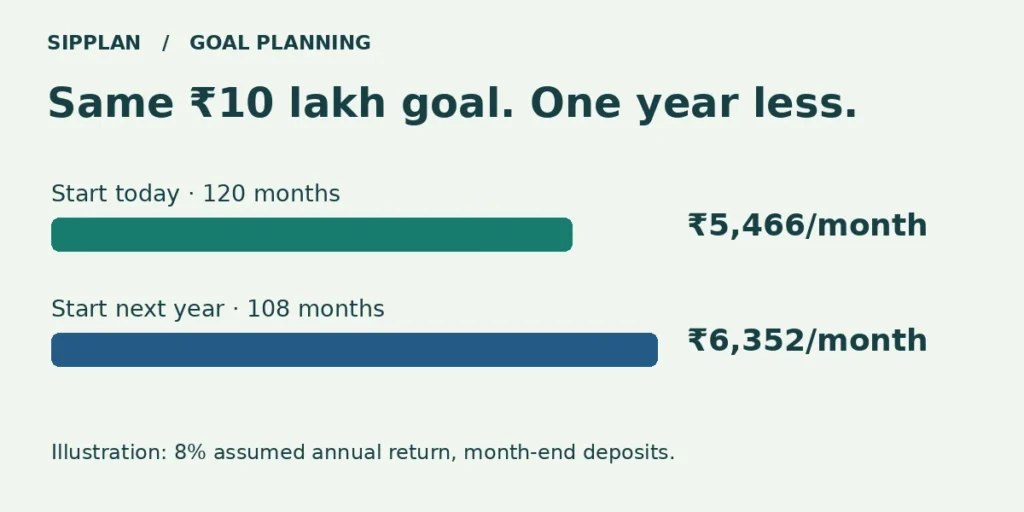
The cost of delaying a SIP depends on what you want to keep fixed. Suppose you need ₹10 lakh in ten years. With an illustrative 8% annual return, starting now takes about ₹5,466 a month. Wait one year and the same goal needs ₹6,352 a month. But if ₹5,000 is all you can afford, the useful question changes. How much less money will be available on the day you need it?
1. Compare two plans with the same deadline
Imagine two savers starting with nothing set aside for this goal. Both need their money on the same day. One makes 120 deposits at month-end. The other waits twelve months and then makes 108 deposits. Each row below holds the target at ₹10 lakh and changes only the assumed return. The rate is divided by twelve for monthly compounding. Figures are rounded to the nearest rupee.
| Assumed return | Start now | Wait one year |
|---|---|---|
| 0% | ₹8,333/month | ₹9,259/month |
| 6% | ₹6,102/month | ₹7,006/month |
| 8% | ₹5,466/month | ₹6,352/month |
| 10% | ₹4,882/month | ₹5,745/month |
The zero-return row is a useful check on the arithmetic. Even when money earns nothing, fitting the same target into fewer paydays raises the monthly requirement. At 8%, starting a year later raises the deposit by about ₹886, or 16.2%. That is the cost of delaying a SIP for this particular target and deadline. It is not a forecast for any fund.
2. Find the cost of delaying a SIP when ₹5,000 is your limit
Keep the instalment at ₹5,000 and leave the deadline alone. At the same illustrative 8% rate, ten years of deposits build approximately ₹9,14,730. Nine years build approximately ₹7,87,148. The difference is around ₹1,27,582. Of that, ₹60,000 consists of the twelve missed deposits. The other ₹67,582 is the growth those early deposits would have accumulated in this model.
There are two shortfalls here. Even starting today, the ₹5,000 plan falls about ₹85,270 short of ₹10 lakh. Starting later adds another ₹1,27,582 to that original shortfall, bringing the total gap to about ₹2,12,852. Separating the two tells you how much of the problem already existed in the monthly budget.
3. Reproduce the comparison with your own numbers
- Open SipPlan’s SIP calculator. Enter ₹5,000 a month, ten years and an assumed return of 8%. Record the estimated final balance.
- Shorten the duration to nine years. Leave the other two values alone. Write both results beside the same target date. Setting a fresh ten-year deadline for the second plan answers a different question.
- For a target-first calculation, try the SEBI Investor goal SIP calculator. Check how the tool handles instalment timing. Deposits made at the beginning of the month receive an extra month of assumed growth compared with the month-end figures here.
For a spreadsheet check, divide the target by the monthly annuity factor. At 8% over ten years, that factor is ((1 + 0.08/12) raised to 120 − 1) divided by (0.08/12). Replace 120 with 108 for a nine-year saving period. At zero return, divide the target by the number of deposits. These examples exclude taxes and charges.
What if you can start small but cannot start in full?
The choice need not be between a full instalment and a year of zero contributions. Suppose you can set aside ₹2,000 at the end of each month in the first year. At the same 8% assumption, that first year’s twelve deposits would grow to about ₹51,033 by the ten-year deadline. That gives the later deposits a smaller target to cover. Compare this option with the zero-contribution first year before deciding which amount fits your household budget.
One way to test it is to keep the first year and the remaining nine years on separate lines in your worksheet. Give both lines the same end date. The first line includes only twelve deposits and then nine years of assumed growth on their balance. The second line starts from zero after the first year. This prevents you from accidentally earning an extra year of growth on the later contributions.
When waiting is unavoidable
Write down which part of the plan has room to move. A discretionary purchase might have a flexible date. A college admission bill usually has a firm deadline. If your goal has several deadlines, calculate each one separately. Our four-year college fee example shows why the amount needed on admission day can differ from the total paid over the course.
If your target is quoted in today’s rupees, estimate the price on the payment date before calculating the monthly investment. If you already have money set aside, count it towards this goal only once. A reserve earmarked for a different bill cannot cover both.
Cost of delaying a SIP when the goal date can move
If you wait one year and also push the spending date back one year, you have restored the original 120 deposits. With the same assumed return, the same instalment again produces the same nominal balance. Your purchase is now a year later. If the price changes during that extra year, recalculate the target before calling the two plans equivalent.
To compare the cost of delaying a SIP fairly, label both results with a calendar month and year. That one detail distinguishes a smaller balance on the original date from an identical balance available twelve months later. For a goal with a fixed deadline, only the first comparison answers the budget question.
Does a higher assumed return solve the shortfall?
A higher input makes the required instalment look smaller. It does not change the amount you can actually save. Compare the 6% and 8% rows and see whether the lower-return scenario still fits the budget. For a fixed-date expense, review the balance periodically and update the gap in rupees. That gives you something concrete to act on while the outcome is still uncertain.
How to adapt the comparison to an existing balance
Say you already have ₹1 lakh earmarked for the goal. The cost of delaying a SIP now depends on what happens to that ₹1 lakh during the year you wait. If it stays invested under the same assumptions in both scenarios, it grows for ten years in both. Deduct its projected value from the ₹10 lakh target once, then calculate the monthly deposits for the remainder. If you plan to spend some of the balance during the year, enter the smaller amount actually available. Otherwise the calculation credits your goal with money that is already spoken for.
What if my monthly contribution rises after a pay increase?
Write the increase down as a rupee amount and give it a start month. A ₹1,000 increase starting in month thirteen gives a different result from a ₹1,000 increase starting in month sixty. In a spreadsheet, make one row per month with the opening balance, growth assumed for that month, deposit and closing balance. When you use month-end deposits, apply growth to the opening balance and add that month’s contribution afterwards. Change only the deposit column when you model a pay increase. The last row then shows whether the increase closes the gap by the original date.
What should I keep from this exercise?
Keep three numbers together: the cash target on the due date, the monthly amount affordable today and the gap under your lower-return assumption. Record the date you ran the calculation. When a fee notice or salary change arrives, repeat the same comparison with the new inputs. This makes the cost of delaying a SIP a budget you can review, rather than a single estimate you have to trust for ten years.
Source and method. SipPlan calculated the examples independently on 20 November 2026. The SEBI Investor cost of delay calculator provides another way to explore this timing effect. For education only. Mutual fund returns are market-linked.
