

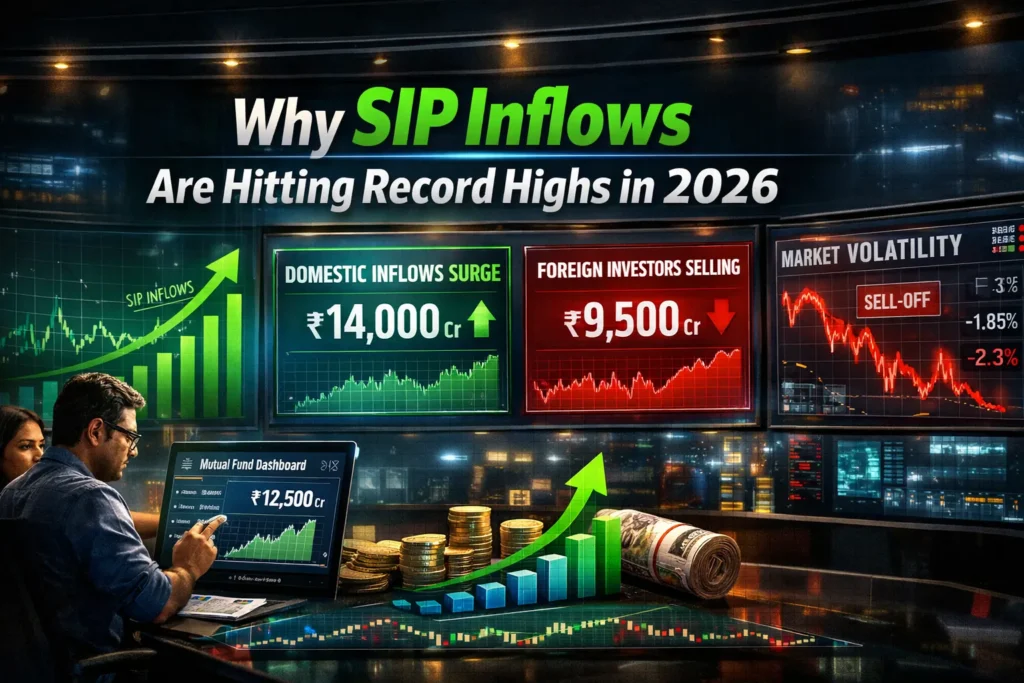
SIP Inflows Hitting Record Highs in 2026: 7 Reasons Investors Keep Buying Even in Volatile Markets
SIP inflows hitting record highs in 2026 is one of the biggest mutual fund stories in India right now. Even while markets remain volatile, foreign investors keep selling, and headlines stay nervous, retail investors are still putting money into SIPs with strong discipline.
That surprises many people. Usually, investors expect fear to reduce inflows. But this year is showing something different. Retail participation is staying resilient, and that says a lot about how investor behaviour is changing in India.
If you have already read our article on SIP During War 2026 – Should You Stop or Invest More?, this trend makes even more sense. The real story is not just volatility. The real story is how investors are reacting to it.
1. SIP Inflows Hitting Record Highs in 2026 Shows Investors Are Thinking Longer Term
The first reason behind SIP inflows hitting record highs in 2026 is simple: more investors now understand that SIP is a long-term process, not a short-term market prediction tool.
A SIP works best when it continues through multiple market phases. Investors who stop and restart every time markets turn uncertain often break the exact benefit SIPs are meant to provide.
This mindset looks stronger in 2026 than before. More investors now seem willing to continue buying even when the market environment is uncomfortable.
2. Retail Investors Are Becoming More Comfortable With Volatility
Volatility still makes people nervous, but investors are slowly becoming more familiar with it. Corrections no longer shock people the way they once did.
Earlier, many first-time investors treated every market fall as a sign that something had gone badly wrong. Now, a growing number of investors seem to understand that market declines are part of the real investing journey.
This does not mean investors enjoy falling markets. It simply means they are less likely to abandon a good SIP plan just because conditions have become noisy.
3. SIPs Feel More Practical Than Trying to Time the Market
Another reason for SIP inflows hitting record highs in 2026 is that more people have realised how difficult market timing really is.
Waiting for the “perfect” entry point often turns into delay, confusion, and missed opportunities. A SIP solves that by turning investing into a monthly routine instead of a prediction exercise.
For working professionals and families, that practicality matters a lot. A disciplined monthly system is easier to follow than a strategy built on guessing short-term market moves.
4. Investors Are Connecting SIPs With Real Financial Goals
SIPs are not just being used as a “returns idea” anymore. More investors now connect them with real goals like retirement, children’s education, long-term wealth building, and financial independence.
When money is linked to a real goal, it becomes harder to stop investing just because markets are volatile for a few months.
This is also why many investors keep comparing growth and stability options before choosing their route. If that sounds like you, our guide on SIP vs FD in 2026 can help you think more clearly about risk comfort and long-term discipline.
5. Simpler Fund Choices Are Making SIP Investing Easier
The rise of index funds, flexi cap funds, and clearer category-based fund education is also helping. Investors do not need to feel lost among dozens of complicated products just to get started.
That clarity reduces hesitation. And lower hesitation often means stronger SIP continuity.
Many investors now start with simpler fund categories and then gradually understand how to build their portfolio over time. That is a much healthier pattern than random investing based on tips.
If you are still building your shortlist, you can also read Best Mutual Funds for SIP in India 2027 to understand category roles better.
6. FII Selling Is Not Scaring Retail Investors the Same Way Anymore
One of the most interesting parts of this trend is the contrast between foreign investor selling and retail SIP resilience.
Foreign investors may sell because of global asset allocation decisions, currency pressure, geopolitics, or broader macro concerns. Retail SIP investors often behave differently because their motivation is tied to long-term goals and monthly discipline.
That difference is important. It shows that SIP investors are not reacting to every external move in the same way as institutional capital.
This does not mean retail investors are always “right.” It means their time horizon is different.
7. SIPs Are Becoming a Habit, Not an Event
This may be the biggest reason of all. The strongest investing behaviour is not “I invested because this month looked good.” The strongest behaviour is “I invest because this is what I do every month.”
That is the real meaning behind SIP inflows hitting record highs in 2026. It suggests that SIPs are becoming a habit for many investors, not just a reaction to bullish sentiment.
And once investing becomes a habit, temporary fear loses some of its power.
What This Trend Does Not Mean
This record SIP trend is positive, but it should not be misunderstood.
- It does not mean markets are risk-free.
- It does not mean every mutual fund is a good SIP choice.
- It does not mean valuation and category fit no longer matter.
- It does not mean volatility is over.
It simply means Indian retail investors are showing stronger long-term discipline than many people expected during a volatile phase.
What Smart Investors Should Learn From This
The real lesson is not “keep every SIP blindly forever.” The real lesson is this: if your fund choice is sensible and your goal is long term, short-term volatility should not automatically break your plan.
That is very different from ignoring reality. Investors should still review their fund categories, time horizon, and allocation fit. But they should avoid turning every nervous month into a restart button.
If you also want to understand how regulation may shape mutual fund investing going forward, read our article on New SEBI Mutual Fund Rules 2026.
Final Verdict
SIP inflows hitting record highs in 2026 is more than just a number. It is a behavioural signal. It shows that a growing section of Indian investors is starting to treat SIPs as a disciplined long-term habit rather than a market-timing tool.
That does not remove risk. It does not guarantee short-term returns. But it does show a healthier investing mindset than panic-driven entry and exit behaviour.
In a year full of volatility, foreign selling, and uncertainty, that may be the most important mutual fund story of all: retail investors are still showing up.
Related reading on SipPlan
- SIP During War 2026 – Should You Stop or Invest More?
- New SEBI Mutual Fund Rules 2026: What SIP Investors Must Know
- SIP vs FD in 2026: Which Investment Is Better for Returns, Safety, and Growth?
- Best Mutual Funds for SIP in India 2027
Helpful external references
FAQ
Why are SIP inflows hitting record highs in 2026?
The main reasons are stronger investor discipline, goal-based investing, easier access to mutual funds, and growing acceptance that volatility is part of long-term investing.
Does record SIP inflow mean the market is safe?
No. It means investors are continuing disciplined investing despite volatility. It is a behavioural signal, not a guarantee of short-term safety.
Should investors continue SIPs during volatile markets?
In many cases, yes, if the fund choice and goal timeline are still valid. Volatility alone is usually not enough reason to break a sensible SIP plan.
Are retail investors replacing FIIs in 2026?
Not in a simple one-to-one sense. But retail SIP participation is clearly becoming a more important stabilising force in Indian mutual fund flows.
